 Axle
GitHub
See how your code runs.
Every editor shows where code is stored. Axle shows how it runs, and what your agents changed in it.
Free and open source, for Windows, macOS and Linux.
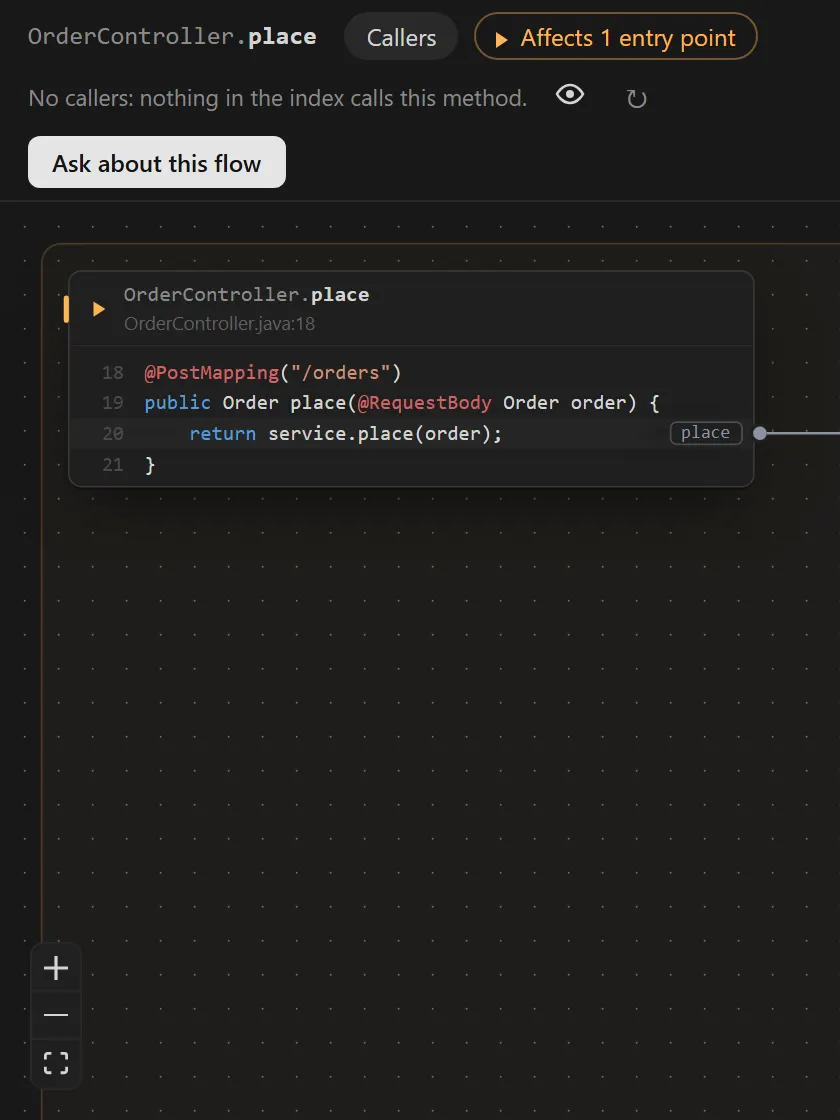
The real canvas, on a small demo shop. Drag to move around; hold Ctrl and scroll to zoom. It opens full screen. More to try.
Your agent changed 2 files. Which endpoints did it reach?
Ask the agent to show what it did, or run Show Git Changes in Flow. One canvas holds the whole change: every endpoint the changed code reaches, cut down to the changed methods, added lines in green and removed lines in red.
Keep or undo each change where you see it. After every prompt, the Agents dock lists the flows that turn touched.
A request leaves your service. Where does it go next?
Pick an endpoint and follow the chain it runs, card by card, to the table it writes. An HTTP call continues into the route it reaches, a message into the listener of its topic or queue, across languages.
Links found by matching a name or a path are drawn dashed, as guesses, so you always know what is certain.
Three agents are running. Which one is waiting for you?
Claude Code, Codex and any CLI run as their real tools, in terminals. The Agents dock ranks what needs you first: an approval with its text, a question, an error, a finished turn you have not read.
Each row shows the model, how full its context window is, and what it costs. Start an agent in its own git worktree and get warned when two agents edit the same file.
Your agent reads a dozen files before you type. Is any of them wrong?
CLAUDE.md and AGENTS.md, rules, skills, subagents, hooks, MCP servers and permissions, on one map, with a health score and what each piece costs in tokens before you type.
Rules whose paths match nothing, broken frontmatter and hooks that never fire are found without an LLM. Permissions you keep granting become proposed rules, applied only when you say so.
The scan of the demo project loads here.
Works with the agents you already use.
Claude Code
Runs in its own terminal, as it does today. Its approvals, questions and context window show up in the dock.
Codex
The same, side by side with Claude Code on the same project, each in its own worktree if you like.
Any CLI
Add the command you run, and it gets a row in the dock and a place on the status island.
Your agent can use the canvas too
Axle's MCP server gives the agent tools to find entry points, read a flow as text and walk you through it as a tour. Ask "how does an order get placed?" and the answer plays on the canvas.
you    how does an order get placed?
agent  find_entry_points  9 endpoints
       flow_text "POST /orders"  12 cards, 3 services
       tour  8 steps, playing on the canvas
Check it yourself.
- MIT licensed
- The whole editor is open source, and it builds on VS Code. Read the licence.
- Released often, updated in place
- Every release has its notes. A running Axle checks for the next one and, on Windows, installs it. Changelog.
- Tested on every change
- The code index is checked against the expected flows of sample projects, and this page's demo is played in a browser, on every pull request. See the runs.
- The canvas above is the real one
- It is the editor's own canvas code, fed by the editor's own index of a demo project. How this page is built.